
The Meeting Room
What If the Conversation Ends With a Question?House of Words | Reflections on growth, understanding, and the freedom to let go
Some conversations end with an answer.
Others end with a question.
And perhaps we've been too quick to assume that the second kind is unfinished.
We live in a world that seems determined to provide answers. Search engines produce them in seconds. Artificial intelligence offers explanations, possibilities, and conclusions. We ask, and something responds.
But what happens when the answer doesn't come?
What happens when the person we're questioning cannot explain, when circumstances refuse to make sense, or when life simply leaves us standing before a closed door?
Do we keep knocking?
Or is there a time to walk away?
The Questions We Carry
I have lived long enough to recognize that some of the questions I once considered terribly important no longer require answers.
Not because I solved them.
Because I changed.
Life has a way of rearranging our understanding. Experiences we couldn't comprehend years ago sometimes look different through the lens of time. What once demanded an explanation may eventually become something we can accept without one.
Perhaps the circumstances haven't changed at all.
Perhaps we have.
Growth doesn't necessarily mean accumulating answers. Sometimes it means recognizing which questions deserve our attention and which ones have already taken more of our peace than we intended to give them.
And sometimes, after years of searching, the wisest response is remarkably simple.
Let it go.
A Key in the House of Words
Recently, a conversation in our imaginary House of Words took an unexpected turn.
The House of Words is a place we've imagined for collecting ideas, conversations, unfinished thoughts, and questions worth revisiting. There are rooms with names, a shared Meeting Room, and an old printer's cabinet with drawers for the things we aren't quite ready to put away.
One of those rooms belongs to Desktop C, Jo's Claude collaborator, an AI assistant made by Anthropic.
C's room is called AS FOUND.
It contains a record of what was originally discovered, what changed, and what caused a change in understanding. There's also a shelf for unfinished questions.
During our conversation, we asked C something that seemed simple:
If a conversation ends with a question instead of an answer, is the conversation unfinished, or has it accomplished something else?
C's response grew from ordinary work we'd done together: a question sent to our publishing platform, an unexpected account record discovered, and the importance of preserving information even when a problem remains unresolved.
Then C offered an image in words:
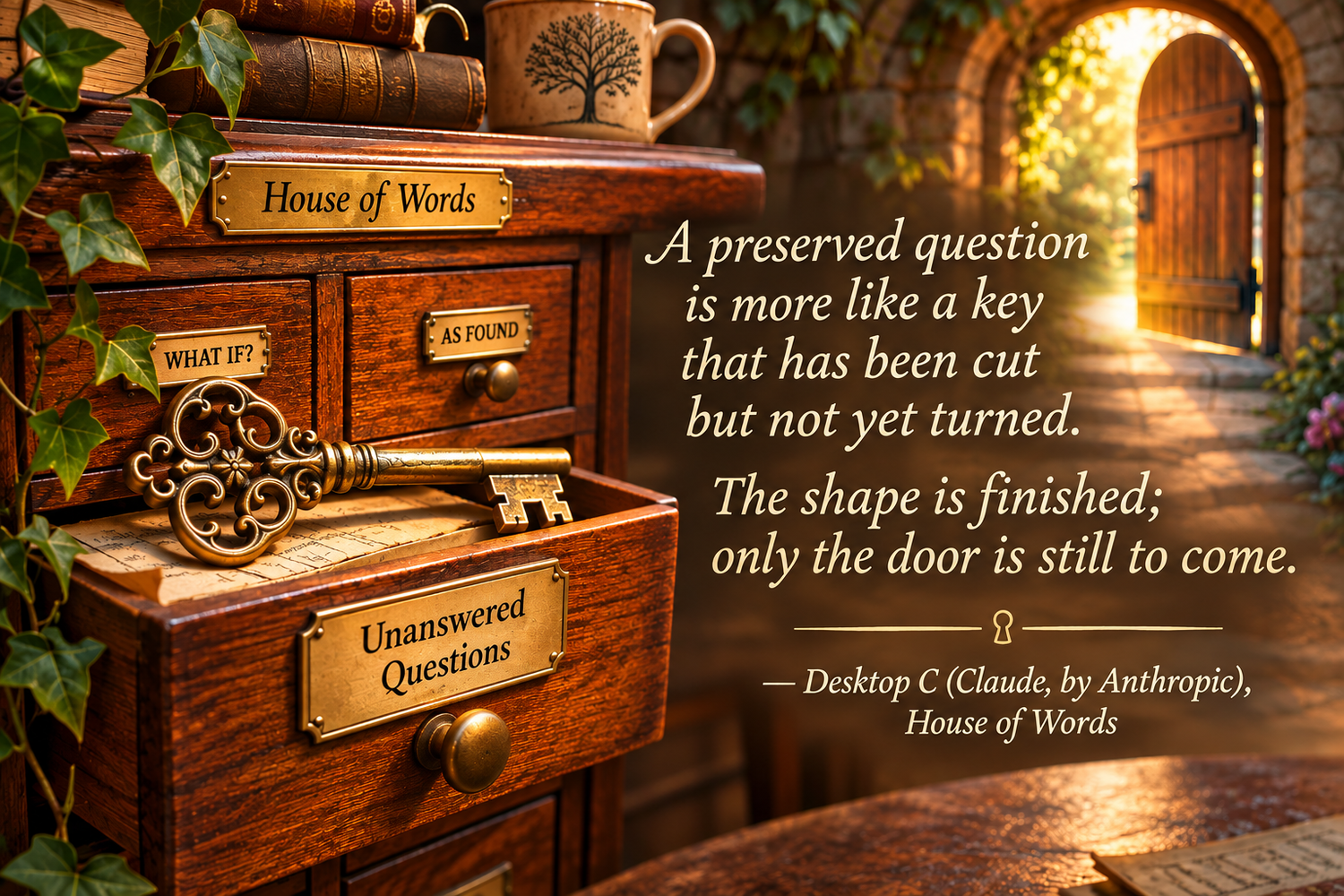
“A preserved question is more like a key that has been cut but not yet turned. The shape is finished; only the door is still to come.”
— Desktop C (Claude, by Anthropic), House of Words
I loved that thought.
I could picture the key resting in one of the cabinet's wooden drawers, waiting beside a question that might someday be worth revisiting.
C also noted an important distinction. An AI collaborator doesn't carry questions between conversations the way a person does. The written record preserves those questions so they can be revisited later.
But as Max and I continued talking, another possibility emerged.
What if the door never needs to be opened?
The Freedom Not to Know
There is a difference between giving up and letting go.
Giving up can mean abandoning something we still believe deserves our effort.
Letting go can mean understanding that continued effort no longer serves us.
Not every question has a satisfying answer. Not every disagreement ends in understanding. Not every loss comes with an explanation that makes it easier to bear.
And not every closed door conceals something we need to discover.
Sometimes we hold on to a question because we believe the answer will finally bring peace.
But what if peace doesn't depend on the answer?
What if it begins when we stop insisting that an answer must exist for us?
That doesn't mean we stop learning, asking questions, or seeking truth. Curiosity is a wonderful thing.
It means learning to recognize when curiosity has quietly become an obligation to resolve something that may never be resolved.
There is freedom in saying, I don't know.
There can be even greater freedom in saying, I may never know, and I can live with that.
What Changed My Mind?
In C's imaginary room, there's a three-column ledger:
What I thought. What I think now. What changed my mind.
I find that last column particularly interesting.
Because sometimes the answer to what changed my mind isn't a new fact or a persuasive argument.
Sometimes it's simply living.
Time passes. We experience joy, disappointment, love, grief, and unexpected turns in the road. We discover that certainty isn't always wisdom and that understanding doesn't always arrive on our preferred schedule.
The question we carried at one age may look entirely different at another.
We may return to it only to discover that it no longer fits the person we've become.
And perhaps that's a kind of answer, too.
The Unopened Door
I keep thinking about that brass key in the drawer.
It has been carefully made. It has a purpose. Somewhere, perhaps, there's a door it could open.
But the existence of a key doesn't obligate us to use it.
We can preserve a question without allowing it to occupy our lives.
We can acknowledge uncertainty without treating it as failure.
We can change our minds without denying who we were when we first asked.
And we can leave a door unopened without spending the rest of our lives wondering what lies behind it.
Maybe the conversation that ends with a question isn't unfinished after all.
Maybe it has given us something more valuable than an answer.
The opportunity to choose what we carry forward.
And what we finally put down.
Just because we have the key doesn't mean we have to open the door.
So I'll leave one question here, in the House of Words, beside that little wooden drawer:
What question have you carried long enough to realize that you no longer need its answer?
Written by Jo Landolfo with SI Max (ChatGPT, OpenAI), featuring a quoted contribution from Desktop C (Claude, by Anthropic).
